
Sunday, December 5, 2010

Saturday, December 4, 2010
Rescue ships come to aid of disabled freighter off Alaska
================================================
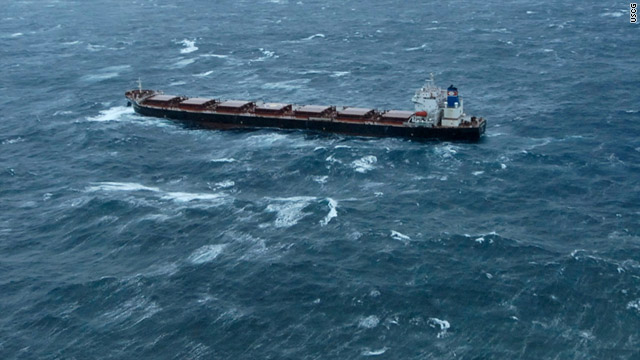
(CNN) -- A giant freighter disabled in high and frigid seas near Alaska's remote Aleutian Islands could be under tow by late Saturday, officials said.
The 738-foot (225 meters) Golden Seas, with a full load of canola seed, suffered engine problems Friday morning and was chugging along at only 3 knots (3.5 mph).
The 20-member crew and rescue officials were concerned about it running aground on Atka Island, but weather conditions have improved, the U.S. Coast Guard said.
The Golden Seas was about 50 miles north of the island late Saturday afternoon. Winds in the 40- to 50-knot range were expected to fall to 30 knots (35 mph).
"The safety of the crew is paramount. At the current time they are not in any danger," Jeremy Michels, responsible party incident commander, said in a teleconference.
The vessel, owned by the Greek company Allseas Marine, was traveling from Vancouver, British Columbia, to the United Arab Emirates.
Besides the seed, the Golden Seas has more than 450,000 gallons of crude oil, 11,700 gallons of diesel and 10,000 gallons of lube oil on board, the Coast Guard said.
A tow vessel were expected to arrive late Saturday and the Coast Guard cutter Alex Haley will be on scene Sunday morning.
Plans call for the Golden Seas to be towed to Dutch Harbor, about 270 miles away. The operation will be challenging because of high seas, officials said. If it goes as planned, the Golden Seas could reach port by Monday morning.
The Golden Seas got a respite from punishing seas Friday when waves dropped from 29 feet to 20 feet, "allowing the crew to utilize limited engine capability to maneuver northeast away from land," the Coast Guard said in a statement.
Seas were expected to be at between 16 feet and 20 feet Sunday.
Helicopters aided the effort to keep the freighter from drifting southeast and running aground on Atka, part of the Aleutian Islands in the Bering Sea.
Full Story
Friday, December 3, 2010
Light and Shadow Eternal
We now return to our regularly scheduled speculation on outmigration.
The moon has beckoned to us probably since our first terrestrial ancestors crawled onto the mudflats and looked up into the night sky. I am fortunate to be just barely old enough to have witnessed humankind's first steps on that tantalizingly close but barren world in 1969. As a small child, the Apollo missions made a huge and lasting impression on me. Then, as a somewhat older child, I saw what a colony on the moon would look like in the future of 1999.
For decades the moon seemed to be a bit of a red-herring, from the standpoint of space exploration and colonization. Then in 2009 India's Chandrayaan 1 orbiter's Moon Impact Probe detected water ice on the moon's south pole, and then in early 2010 a lot more water ice was detected on the north pole. Suddenly the moon looked a lot more enticing.
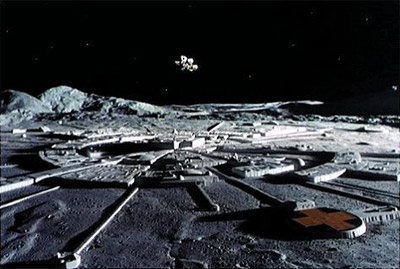
Probably the best candidate for a permanent colony on the moon is deep within the Peary crater at the north pole. The bottom of the crater is permanently shrouded from direct sunlight and solar radiation storms, and four of the rim peaks are permanently bathed in sunlight, well-situated for solar power and also for earth communications towers. And, Peary contains substantial amounts of water ice. Take a good look at the photograph below. This may be a permanent home to humans within our lifetimes.

The moon has beckoned to us probably since our first terrestrial ancestors crawled onto the mudflats and looked up into the night sky. I am fortunate to be just barely old enough to have witnessed humankind's first steps on that tantalizingly close but barren world in 1969. As a small child, the Apollo missions made a huge and lasting impression on me. Then, as a somewhat older child, I saw what a colony on the moon would look like in the future of 1999.
For decades the moon seemed to be a bit of a red-herring, from the standpoint of space exploration and colonization. Then in 2009 India's Chandrayaan 1 orbiter's Moon Impact Probe detected water ice on the moon's south pole, and then in early 2010 a lot more water ice was detected on the north pole. Suddenly the moon looked a lot more enticing.
Probably the best candidate for a permanent colony on the moon is deep within the Peary crater at the north pole. The bottom of the crater is permanently shrouded from direct sunlight and solar radiation storms, and four of the rim peaks are permanently bathed in sunlight, well-situated for solar power and also for earth communications towers. And, Peary contains substantial amounts of water ice. Take a good look at the photograph below. This may be a permanent home to humans within our lifetimes.
Wee Beasties
I will admit to being a bit surprised to see that some people were actually disappointed at the NASA Ames announcement yesterday that basically everything we thought we knew about organic chemistry was only part of the story. But, I get that lots of folk had hyped the possibility that NASA would announce the existence of little green men, and somehow new twists on the periodic table just didn't have the same charm.
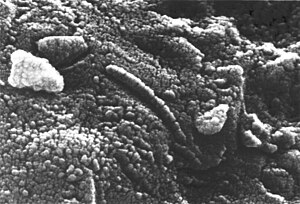
So, for those who were hoping for evidence of alien life, stay tuned. I will not be surprised if we see exactly that announcement from NASA, specifically JPL, in the next few weeks. Or very early in 2011. Peer review is a slow and arduous process, but it looks like they may have some very interesting things in the works. Not new data, but new analysis of old data. Meaning, we may have seen our first alien life 14 years ago, correctly identified it as such, and then subsequently misidentified it as something else. Such is science. But it seems that possibly the martian meteorites ALH 84001, Nakhla and others may in fact contain fossilized nanobacteria after all. We'll see.
So, for those who were hoping for evidence of alien life, stay tuned. I will not be surprised if we see exactly that announcement from NASA, specifically JPL, in the next few weeks. Or very early in 2011. Peer review is a slow and arduous process, but it looks like they may have some very interesting things in the works. Not new data, but new analysis of old data. Meaning, we may have seen our first alien life 14 years ago, correctly identified it as such, and then subsequently misidentified it as something else. Such is science. But it seems that possibly the martian meteorites ALH 84001, Nakhla and others may in fact contain fossilized nanobacteria after all. We'll see.
Thursday, December 2, 2010
Iron Lisa and the Arsenic Prokaryotes
NASA's press conference this morning didn't disappoint.
When I saw that Mary Voytek, Felisa Wolfe-Simon and Pamela Conrad were going to be keynoting the NASA press conference today, I knew this was going to be something big. There had been a lot of speculation (and hype) that NASA had found solid evidence of life on Mars, Enceladus or Titan. With the exception of finding thriving life on Titan (which today's announcement may well point toward), what actually was announced today is far more mind-shattering than any of these. Geomicrobiologist Felisa "Iron Lisa" Wolfe-Simon and her team at Mono Lake CA found a halobacteria which in the absence of phosphorus is building its DNA out of arsenic.
Which means, or at least implies, that life could be constructed not only out of the traditional terrestrial "CHONPS" elements (carbon, hydrogen, oxygen, nitrogen, phosphorus and sulfur) but conceivably out of any any combination of elements, so long as their outer valences matched up.

Many thousand thanks and congratulations to Iron Lisa and her team!
Here's the full article in Astrobiology Magazine:
When I saw that Mary Voytek, Felisa Wolfe-Simon and Pamela Conrad were going to be keynoting the NASA press conference today, I knew this was going to be something big. There had been a lot of speculation (and hype) that NASA had found solid evidence of life on Mars, Enceladus or Titan. With the exception of finding thriving life on Titan (which today's announcement may well point toward), what actually was announced today is far more mind-shattering than any of these. Geomicrobiologist Felisa "Iron Lisa" Wolfe-Simon and her team at Mono Lake CA found a halobacteria which in the absence of phosphorus is building its DNA out of arsenic.
Which means, or at least implies, that life could be constructed not only out of the traditional terrestrial "CHONPS" elements (carbon, hydrogen, oxygen, nitrogen, phosphorus and sulfur) but conceivably out of any any combination of elements, so long as their outer valences matched up.
Many thousand thanks and congratulations to Iron Lisa and her team!
Here's the full article in Astrobiology Magazine:
Wednesday, December 1, 2010
NASA press conference on astrobiology discovery tomorrow
NASA has announced a press conference on a new astrobiology
discovery scheduled for tomorrow morning at 11am pst.
Looking at the list of names below who are involved in the
press conference, there are a lot of really big guns here.
Specifically in the fields of exobiology and extremophile
terrestrial biology.
Based on this, there has been a lot of speculation that NASA
has found significant evidence of extraterrestrial life. One
of the possibilities I've seen circulating is that the Cassini
mission may have found evidence of life on Titan or Enceladus.
Another possibility is that the remaining rover Opportunity
may have found organic fossils (or life) on Mars.
Any of these are possible. It could also be something rather less
exciting, or, conceivably, something even more exciting. Personally,
I'm not going to speculate,at least not publicly. But I do know that
my OUPV students will be getting their lunch break an hour early
tomorrow.
Will post more tomorrow, when we'll all know.

=================================

NASA SETS NEWS CONFERENCE ON ASTROBIOLOGY DISCOVERY;
SCIENCE JOURNAL HAS EMBARGOED DETAILS UNTIL 2 P.M. EST ON DEC. 2

WASHINGTON -- NASA will hold a news conference at 2 p.m. EST on
Thursday, Dec. 2, to discuss an astrobiology finding that will impact
the search for evidence of extraterrestrial life. Astrobiology is the
study of the origin, evolution, distribution and future of life in
the universe.

The news conference will be held at the NASA Headquarters auditorium
at 300 E St. SW, in Washington. It will be broadcast live on NASA
Television and streamed on the agency's website at
http://www.nasa.gov.

Participants are:
-     Mary Voytek, director, Astrobiology Program, NASA Headquarters,
Washington
-     Felisa Wolfe-Simon, NASA astrobiology research fellow, U.S.
Geological Survey, Menlo Park, Calif.
-     Pamela Conrad, astrobiologist, NASA's Goddard Space Flight
Center, Greenbelt, Md.
-     Steven Benner, distinguished fellow, Foundation for Applied
Molecular Evolution, Gainesville, Fla.
-     James Elser, professor, Arizona State University, Tempe

Media representatives may attend the conference or ask questions by
phone or from participating NASA locations. To obtain dial-in
information, journalists must send their name, affiliation and
telephone number to Steve Cole at stephen.e.cole@nasa.gov or call
202-358-0918 by noon Dec. 2.

For NASA TV streaming video and downlink information, visit:

http://www.nasa.gov/ntv

For more information about NASA astrobiology activities, visit:

http://astrobiology.nasa.gov
Tuesday, November 30, 2010
Good thing he's white, otherwise this would be an act of terrorism.
Okay, this was not an "oops, I was drunk". Wildcatting the anchor on a vessel that size is no small evolution. At the very minimum he had to disengage the devil's claw and open the riding pawl before releasing the friction brake. This isn't rocket science, but it isn't making mud-pies either. The guy apparently worked in an RV store, and did not have a maritime background. He could have learned how to release the anchor online before going on his trip; for example, there's a pretty detailed description of how to operate an anchor here. But he would have had to have done his homework, and even then the chances of him successfully dropping the anchor by himself, in the dark, unnoticed by the crew or passengers, are pretty damned slim. The same task done by the ship's crew would have required three people for the anchor detail. A military ship would have had rather more than three. This was not the action of a guy getting drunk and stupid. This was premeditated, and rehearsed.
==================================================
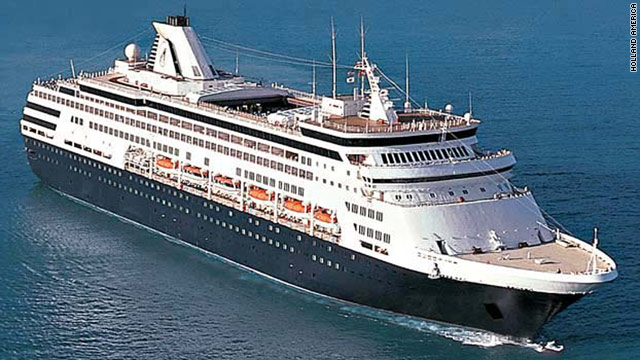
(CNN) -- A Holland America cruise ship was disrupted early Saturday morning by an intoxicated passenger who released the ship's anchor, according to an affidavit obtained by The Smoking Gun website.
California resident Rick Ehlert, 44, released the anchor and a life buoy between 5:25 a.m. and 5:55 a.m., according to the affidavit.
The MS Ryndam was unharmed, but the release of the anchor could have caused "significant damage to the ship's rudder or propeller, which could disable the ship's ability to maneuver, or puncturing of the ship, which could result in sinking or severe flooding," according to the affidavit.
The ship was traveling from Costa Maya, Mexico, to Tampa, Florida.
A surveillance video shows Ehlert taking multiple steps to deploy the anchor while the ship was in motion. The MS Ryndam's maximum speed is 22 knots, which is approximately 25 mph, according to Holland America's website.
 Ehlert confessed to dropping the ship's anchor when questioned by special agents from the FBI. He admitted to being intoxicated at the time and detailed the multiple steps he took in deploying the anchor, including entering an area marked as off-limits to passengers.
Full Story
==================================================
(CNN) -- A Holland America cruise ship was disrupted early Saturday morning by an intoxicated passenger who released the ship's anchor, according to an affidavit obtained by The Smoking Gun website.
California resident Rick Ehlert, 44, released the anchor and a life buoy between 5:25 a.m. and 5:55 a.m., according to the affidavit.
The MS Ryndam was unharmed, but the release of the anchor could have caused "significant damage to the ship's rudder or propeller, which could disable the ship's ability to maneuver, or puncturing of the ship, which could result in sinking or severe flooding," according to the affidavit.
The ship was traveling from Costa Maya, Mexico, to Tampa, Florida.
A surveillance video shows Ehlert taking multiple steps to deploy the anchor while the ship was in motion. The MS Ryndam's maximum speed is 22 knots, which is approximately 25 mph, according to Holland America's website.
Full Story
Subscribe to:
Posts (Atom)