Search This Blog

Friday, December 24, 2010

Dragon Spacecraft Returns to Earth: now just 20 more years to the DC-3

The SpaceX Dragon spacecraft successfully returned to earth, bringing us one giant leap closer to a commercial replacement for NASA's Space Shuttle program. This, along with the impending completion of Spaceport America and similar advances from a number of other companies, really heralds the beginning of an entirely new phase of space exploration.

For comparison, the first scheduled commercial airline flight in the United States was in 1914. The Ford/Stout Trimotor became the first successful commercial airliner in 1925. Boeing built the first 237 in 1933, followed by the Douglas DC-3 in 1935. 16,079 DC-3s were built, and a surprisingly large number of them remain in service to this day. It was, and is, one hell of an airplane.

If this is any reasonable indication, commercial civilian space travel could be commonplace and affordable by 2030. We just need somebody to invent a spacefaring equivalent of the DC-3.


DC-3: A collection of parts flying in loose formation


CAPE CANAVERAL -- On December 8, SpaceX became the first commercial company in history to re-enter a spacecraft from Earth orbit. SpaceX launched its Dragon spacecraft into orbit atop a Falcon 9 rocket at 10:43 AM EST from Launch Complex 40 at the Cape Canaveral Air Force Station in Florida. The Dragon spacecraft orbited the Earth at speeds greater than 7,600 meters per second (17,000 miles per hour), reentered the Earth’s atmosphere, and landed just after 2:00 PM EST less than one mile from the center of the targeted landing zone in the Pacific Ocean.

This marks the first time a commercial company has successfully recovered a spacecraft reentering from Earth orbit. It is a feat previously performed by only six nations or government agencies: the United States, Russia, China, Japan, India, and the European Space Agency.
As the very first flight under the Commercial Orbital Transportation Services (COTS) program, COTS Demo 1 followed a nominal flight profile that included a roughly 9.5-minute ascent, two Earth-orbits, reentry and splashdown. Falcon 9 delivered Dragon to orbit with an inclination of 34.53 degrees—a near bull’s-eye insertion.

Dragon’s first-ever on-orbit performance was 100% successful in meeting test objectives including maintaining attitude, thermal control, and communication activities. While in orbit, eight free-flying payloads were successfully deployed, including a U.S. Army nanosatellite—the first Army-built satellite to fly in 50 years.

Liftoff marked the second flight of SpaceX’s Falcon 9 rocket, which performed nominally during ascent. Nine Merlin engines, which generate one million pounds of thrust in vacuum, powered the first phase of flight. The rocket reached maximum dynamic pressure (the point at which aerodynamic stress on a spacecraft in atmospheric flight is maximized, also known as Max Q) approximately 1.5 minutes after launch. The first stage separation occurred a little over three minutes into flight. The single Merlin Vacuum engine of Falcon 9’s second stage then ignited to continue carrying the vehicle towards its targeted orbit.

Dragon’s PICA-X heat shield protected the spacecraft during reentry from temperatures reaching more than 3,000 degrees F. SpaceX worked closely with NASA to develop PICA-X, a SpaceX variant of NASA’s Phenolic Impregnated Carbon Ablator (PICA) heat shield.
SpaceX chose PICA for its proven ability. In January 2006, NASA’s Stardust sample capsule returned using a PICA heat shield and set the record for the fastest reentry speed of a spacecraft into Earth's atmosphere — experiencing speeds of 28,900 miles per hour.

NASA made its expertise and specialized facilities available to SpaceX as the company designed, developed and qualified the 3.6 meter PICA-X shield it in less than 4 years at a fraction of the cost NASA had budgeted for the effort. The result is the most advanced heat shield ever to fly. It can potentially be used hundreds of times for Earth orbit reentry with only minor degradation each time — as proven on this flight — and can even withstand the much higher heat of a moon or Mars velocity reentry.

At about 10,000 feet, Dragon’s three main parachutes, each 116 feet in diameter, deployed to slow the spacecraft's decent to approximately 16-18 ft/sec, ensuring a comfortable return ride that will be required for manned flights. Oversized parachutes are critical in ensuring a safe landing for crew members. Even if Dragon were to lose one of its main parachutes, the two remaining chutes would still ensure a
safe landing.

This was the first flight under NASA’s COTS program to develop commercial resupply services to the International Space Station. After the Space Shuttle retires, SpaceX will fly at least 12 missions to carry cargo to and from the International Space Station as part of the Commercial Resupply Services contract for NASA. The Falcon 9 rocket and Dragon spacecraft were designed to one day carry astronauts; both the COTS and CRS missions will yield valuable flight experience toward this goal.

With recovery of the Dragon spacecraft, SpaceX became the first company in history to successfully re-enter a spacecraft from Earth orbit. SpaceX has only come this far by building upon the incredible achievements of NASA, having NASA as an anchor tenant for launch, and receiving expert advice and mentorship throughout the development process.

SpaceX would like to extend a special thanks to the NASA COTS office for their continued support and guidance throughout this process. The COTS program has demonstrated the power of a true private/public partnership and we look forward to the exciting endeavors our team will accomplish in the future.

============================

The entire story, and lots more pictures, is here.

Thursday, December 23, 2010

Tempest in a Teacup

The two Koreas have been "on the brink of war", or at least, on the brink of rekindling an existing war which had burned down to embers, since the Armistice was signed in 1953. So, the fact that we again find the Koreas rattling their respective sabers is not altogether surprising. North Korea has been spoiling for a fight for decades. What makes this period of time potentially different is that subsequent to the sinking of the South Korean warship Cheonan and the artillery shelling of Yeonpyeong Island, South Korea is now spoiling for war even more than the North. Which, I imagine, was the point of the attacks.

Last week New Mexico's governor Bill Richardson met with North Korea to try to "turn it down a notch", and it seems he may have succeeded. South Korea carried out its previously scheduled military exercises this week, and as of this writing North Korea has responded only with more of the same rhetoric they've been spouting for years. This may be as much of a stand-down as we can hope for at this point. If the two Koreas revert to hurling harsh words at each other instead of ordnance, that's more than fine in my book. Absolutely no good can come of Korea's personal cold-war turning hot. It is almost impossible to imagine some 20,000,000 troops engaged in combat on a peninsula only a little bigger than Florida, the South armed with some of the most technologically advanced war machines in the world and the North armed only with 1950's vintage Soviet-era relics, but lots and lots of them. And chemical, biological and atomic weapons.
We can only hope that diplomacy, or at the very least a somewhat enlightened sense of self-preservation, will keep the tinder box from being sparked.

North Korean Romeo class attack submarine


South Korean Sohn-Wonyil class attack submarine

Gale Warning East Entrance Strait of Juan de Fuca

Synopsis...A 984 MB LOW ABOUT 320 NM SW OF THE QUEEN CHARLOTTES WILL REMAIN QUASISTATIONARY OFF THE BRITISH COLUMBIA COAST THROUGH FRI. THIS COMBINED WITH HIGHER PRES E OF THE CASCADES WILL RESULT IN STRONG SE FLOW ACROSS MUCH OF THE AREA THROUGH FRI. MEANWHILE...EXPECT A COLD FRONT TO STALL OVER THE COASTAL WATERS ON FRI BEFORE WEAKENING THIS WEEKEND.

Late Afternoon: SE wind around 35 kt, with gusts as high as 46 kt. A chance of rain. Wind waves around 8 ft.

Tonight: SE wind 31 to 35 kt, with gusts as high as 46 kt. A chance of rain. Wind waves around 8 ft.

Here's a graph of the recent wind gust speeds at Smith Island.

Wednesday, December 22, 2010

Ice Volcanoes on Titan

Not quite as cool as the beer volcanoes in the Pastafarian version of heaven, but still pretty cool.


NASA's Cassini spacecraft has found possible ice volcanoes on Saturn's moon Titan that are similar in shape to those on Earth that spew molten rock.

Topography and surface composition data have enabled scientists to make the best case yet in the outer solar system for an Earth-like volcano landform that erupts in ice. The results were presented at the American Geophysical Union meeting in San Francisco.

"When we look at our new 3-D map of Sotra Facula on Titan, we are struck by its resemblance to volcanoes like Mt. Etna in Italy, Laki in Iceland and even some small volcanic cones and flows near my hometown of Flagstaff," said Randolph Kirk, who led the 3-D mapping work, and is a Cassini radar team member and geophysicist at the U.S. Geological Survey (USGS) Astrogeology Science Center in Flagstaff, Ariz.

Scientists have been debating for years whether ice volcanoes, also called cryovolcanoes, exist on ice-rich moons, and if they do, what their characteristics are. The working definition assumes some kind of subterranean geological activity warms the cold environment enough to melt part of the satellite’s interior and sends slushy ice or other materials through an opening in the surface. Volcanoes on Jupiter’s moon Io and Earth spew silicate lava.

Some cryovolcanoes bear little resemblance to terrestrial volcanoes, such as the tiger stripes at Saturn’s moon Enceladus, where long fissures spray jets of water and icy particles that leave little trace on the surface. At other sites, eruption of denser materials might build up volcanic peaks or finger-like flows. But when such flows were spotted on Titan in the past, theories explained them as non-volcanic processes, such as rivers depositing sediment. At Sotra, however, cryovolcanism is the best explanation for two peaks more than 3,000 feet high with deep volcanic craters and finger-like flows.

Full Story

Tuesday, December 21, 2010

Happy Yule, and Seattle Astronomy

The big seas on the Strait yesterday meant that I was stuck in Victoria, which as far as such things go is a pretty good place to be stuck. Around 11pm the eclipse was about 70%, visible only occasionally through the breaks in the clouds. We got a small bit of a weather window about that time, so we lit off the main engines, threw off our mooring lines and made a run for the border. We still had maybe 35 knots of wind and steep seas up to about 6', but much, much better than what we'd had on the northbound leg yesterday morning. By the time the eclipse was total it was only occasionally visible as a somewhat lighter patch in the dark clouds. By the time we got to Point Wilson it was raining, which continued through the night. We did get one very brief peek at the moon as it was coming out of the eclipse, but that was about it. My wife, who was here in Seattle, was leading a low-tide beach walk, and they were able to watch the eclipse for a longer time before the rain socked in.

I went out this afternoon to see the sun as it kissed the Tropic of Capricorn today around 3:38pm local, but the sky was remarkably uniformly gray. Usually you can at least guess form the shadows or a lighter patch of the sky where the sun might be, but today was not such a day. Tomorrow morning we'll get up to watch the sunrise of the longest night from the Admiral overlook, or at least watch the sky turn from dark ray to light gray. It is, you know, a Seattle tradition.
 

Happy Yule, y'all.

Sunday, December 19, 2010

Dark Side of the Moon, and a Pop-Quiz

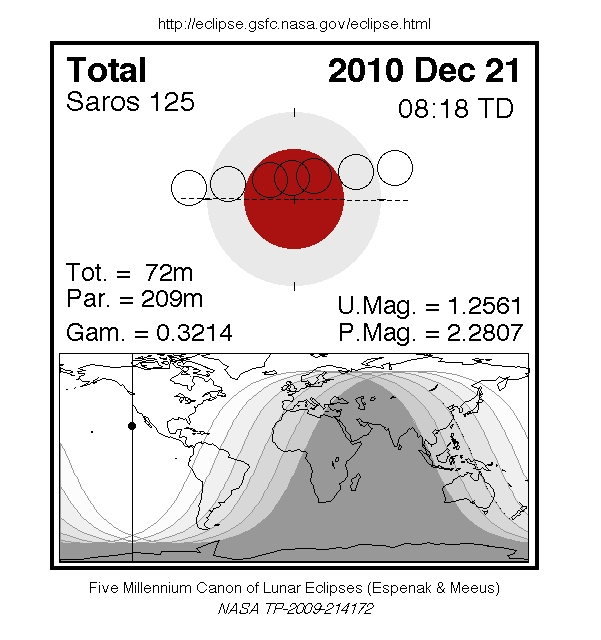
Tomorrow night's full lunar eclipse should prove spectacular, should we be fortunate enough to see it. Here's the timeline of the eclipse, both in Universal (Greenwich) Time and Pacific Standard Time. Especially cool is the fact that the maximum eclipse will happen at a longitude of 124° 04' W, about the longitude of Cape Disappointment and the Columbia River bar, and the Olympic Mountains.

Penumbral Eclipse Begins:       05:29:17 UT    21:29:17 PST (9:29:17pm Monday)
Partial Eclipse Begins:             06:32:37 UT    22:32:37 PST (10:32:37pm Monday)
Total Eclipse Begins:               07:40:47 UT    23:40:47 PST (11:40:47pm Monday)
Maximum Eclipse:                   08:16:57 UT    00:16:57 PST (12:16:57am Tuesday)
Total Eclipse Ends:                  08:53:08 UT    00:53:08 PST (12:53:08am Tuesday)
Partial Eclipse Ends:                10:01:20 UT    02:01:20 PST (2:01:20am Tuesday)
Penumbral Eclipse Ends:         11:04:31 UT     03:04:31 PST (3:04:31am Tuesday)

So, if you happen to be out tide-pooling  in Seattle tomorrow evening, if the weather should happen to cooperate (it doesn't look promising) you'll have an amazing eclipse to look for octopi and sea stars under.


The low tide in Seattle tomorrow evening is -2.1ft at 22:13 (10:13pm) PST.

So, here's the pop-quiz, for my Celestial Navigation students and for anyone else who happens to be following this. If you happen to be especially brave you can post your answers in the Comments, or you can just email me if you like. The first person to get both questions right will get, I don't know, I'll find something cool to send you. The first question should be pretty easy for for anyone with a rudimentary understanding of celestial navigation or astronomy. The second is rather more esoteric. Here goes:

1) The lunar eclipse is happening the day before the December solstice. I've already given the Greenwich Hour Angle of the moon at this time; what is the declination of the moon at the time of the eclipse? Don't look it up, just think about it. Answers within a degree count, answers within an arc-minute tell me you probably cheated!

2) The low tide quoted was measured at 122° 20' W (Pier 55 in Elliott Bay), so the moon's meridian transit of Seattle will happen about seven minutes before the maximum eclipse, about 00:10 (12:10am) PST, about two hours after the low tide. So, for all intents and purposes, the sun and the moon are on Seattle's meridian at roughly the time of the lowest low tide. Bowditch (and every other navigation text) tells us that at this time the tide should be at or near high. How is it possible that the tide in Seattle is almost exactly perpendicular to the moon and sun's gravity?

Enjoy!

Friday, December 17, 2010

Never tell me the odds.

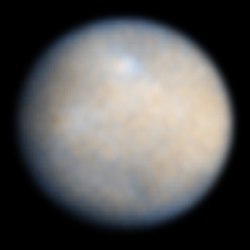
In our discussion of possible new locations for human habitation in the solar system, I neglected one candidate which bears consideration. Especially given the fact that Saturn's tiny moon Enceladus "made the cut", the dwarf planet Ceres should at least be considered.


We don't know a great deal about Ceres, yet. We will know a great deal more in February of 2015 when the Dawn spacecraft arrives there, after its flyby of Vesta. Here's what we do know, compared to Enceladus:

                                      Ceres                                          Enceladus          

Size (Diameter)              943 km                                         504 km
Gravity                           0.03g                                            0.01g
Distance from Earth       250,000,000 km                            1,500,000,000 km

So, Ceres is about twice the diameter of Enceladus, with three times the gravity (although it is still minute: a 200 lb person on Ceres would weigh 6 lbs on Ceres as opposed to 2 lbs on Enceladus), and Ceres is about five and a half times closer than Enceladus. Like Enceladus and Callisto, Ceres has water ice on her surface and likely liquid water below this. Unlike Enceladus, Ceres also has substantial amounts of carbonaceous rock on its surface, which could potentially be utilized as building materials. 

Star Wars fans may balk at the idea of establishing a colony or outpost in the middle of an asteroid field, but the asteroid population of the Main Belt is actually quite sparse, and the asteroids are all orbiting the sun in similar ways so that the relative motion of any two adjacent Main Belt asteroids is very small. The greater risk is from solar radiation, which Ceres, unlike the surfaces of Enceladus or Callisto, is completely unprotected from by Saturn's or Jupiter's magnetospheres.

So, for all intents and purposes, Ceres completes the list of likely candidates for human settlement in the solar system in the near future.

For the record, See Threepio was a pessimist. The actual odds of a spaceship accidentally colliding with an asteroid in the Main Belt are less than one in one billion.