A small blog for marine navigation, astronomy, space exploration, Project Orion (DARPA's "100-year starship"), meteorology, boating and matters pertaining to maritime education and the maritime industry. I am a USCG licensed captain, and an instructor at a number of maritime schools in the Seattle area.
Search This Blog
Wednesday, December 9, 2020
Fly like an Eagle...but don't land like one
Because most of the press today is a bit fixated on the final few seconds of the flight, I'm instead posting a photo from when it was still flying nominally. It was, in all, a very good test flight. And yes, in future flights, SpaceX will certainly improve on the final few seconds of flight as well, because they're also super important.
Saturday, December 5, 2020
Hayabusa2 Returns
Thursday, December 3, 2020
Rock On, Chang'e
Tuesday, December 1, 2020
Monday, November 30, 2020
Rip van Winkle
Yeah, apparently. Crew Dragon has successfully gotten astronauts to the International Space Station and back, the US Navy has confirmed the existence of UFOs, and we went through an entire presidency. And there's a pandemic?
Okay, well, let me get some coffee going, and see where we go from here.
Monday, August 24, 2015
The Darkest Place
A possible solution for this is to instead mount the mirrors on a fixed surface. There have already been proposals for building large telescopes on the far side of the moon, shielded from terrestrial radio interference. NASA has even demonstrated that large astronomy-grade mirrors can be constructed in-situ from lunar regolith. A telescope of this scale would have many applications and purposes besides viewing exoplanets, but this would be its primary purpose.
I would like to propose that instead of the lunar far-side, a better location for an optical (and maybe radio as well) telescope would be inside the basin of Peary crater. I've discussed the unique properties of Peary in this blog previously, in the context of human colonization. But briefly, Peary crater, by virtue of being situated on the north pole, has the triple virtue of a basin which is constantly in darkness and protected from solar radiation, a rim that is in constant sunlight for solar power, and a substantial amount of water ice on the floor of the basin. Shackleton crater on the lunar south pole is similar in many respects, and would similarly be an excellent site for this; however Peary is about 80 km in diameter and Shackleton is only about 20 km, so Peary would afford space for a much larger telescope.
Because the basin is always "aimed" at the moon's northern sky, and the same part of the sky is always visible throughout the month and throughout the year, very detailed long-term observations could be made unhindered of this part of the sky. Yes it would be limited to only this part of the sky; however, many space-based telescopes, including NASA's Kepler Space Telescope, have similarly limited fields of view.
And yes, a small astronomical observation outpost and research facility could provide the seed of a human colony in Peary crater as well. In later posts we'll be discussing the advantages of establishing a lunar colony over either Mars, Venus or orbital stations; a moon-based space telescope (at whatever location) could be a very good beginning to a robust lunar city.
Monday, July 13, 2015
Pluto Day!!!
New Horizons must first be aimed at Pluto (and it's companion planet Charon; apparently NASA has officially stopped calling it a "moon") in order to get photographs and other data during the flyby. Closest point of approach to Pluto will be at 4:49am pdt, but it will continue photographing and collecting data on Pluto for at least several hours after the flyby. Then New Horizons will realign itself to aim its antenna back toward earth. It will first send a short ping to tell the mission team that the spacecraft made it through the Pluto system without mishap, and that the data was collected and is safely in NH's memory banks. This ping will take about four and a half hours to travel from Pluto back to Earth at the speed of light.
Then New Horizons will begin transmitting its preliminary data package. These will include low resolution (about the quality of a JPEG) images of Pluto and Charon during the flyby. Due to the highly attenuated signal crossing some three billion kilometers of interplanetary space, the baud rate of the transmissions will be maddeningly slow. Once received on earth they must be processed and analyzed.
Wednesday (15 July) at noon pdt, NASA will hold a press conference and release the first series of low resolution photos. This is the first new NASA press conference for this mission that will have any real information in it. High resolution photos are forthcoming, but will take about nine months to arrive.
Sunday, June 28, 2015
Childhood's End
There's a lot going on right now in the realm of space exploration. The Dawn mission to Ceres is getting very interesting, the New Horizons mission will reach Pluto and Charon in two weeks; this is all huge, and I haven't posted anything here at all about any of it for a couple of months, due mostly to simple writer's block. Sad about that, and hoping to do better.
So, this morning the SpaceX CRS-7 Dragon/Falcon 9 cargo mission to the International Space Station failed. Notably it was the third failure of a cargo vessel to the ISS in the past eight months, after the Orbital ATK Antares back in October and the Russian Progress 59 in April. In the scheme of such things, this really is not a big deal. The ISS crew have enough provisions until October, and there's another Progress flight scheduled for this Friday. Nobody was hurt, and out of nineteen total Falcon 9 launches since 2010, one catastrophic failure is right at the 5% failure rate which is the rough median for orbital launches.
So, why does this feel like such a monumental blow to the commercial space program, and to spaceflight in general? Rockets explode, it's one of the things they do. When the Antares exploded, spectacularly, last fall, it made the news of course, and people speculated about whether or not Orbital would survive. But nobody speculated about whether or not spaceflight itself would survive. That would have been crazy. But today I've seen that speculation in the media, in chat rooms and other online forums, in all kinds of places that are populated by people who actually understand spaceflight. In the NASA press briefing this morning you could feel that current as well, even though they did a very good job of presenting the rational analysis of this being just another rocket explosion. You could even see it in Charlie Bolden's demeanor this morning. I felt it too.
The difference is not in the scope or magnitude of the loss of the Falcon 9 rocket. We lose rockets. The difference is that this is SpaceX.
For several years now there has grown an idea that the brilliant Elon Musk was doing what no other entity had ever been able to do before. That the founder of Pay Pal was somehow smarter than all of the engineers at NASA, Roscosmos, ESA, Boeing or Lockheed, and had figured out how to make spaceflight safe and affordable when all of the others had failed. With each successful Falcon 9 flight this became easier to believe, largely because we really wanted to believe it. Even Musk's competitors watched him to see if they could emulate his success.
Underlying this was sometimes a sense that SpaceX didn't know what they didn't know, and that through trial and error they would eventually come to look more like Boeing, Lockheed and other "old space" companies. But, we wanted this to not be true. We wanted spaceflight to be as easy, safe and affordable as Musk believed it to be.
Today we learned that Tsiolkovsky doesn't play favorites. And in many ways, today SpaceX finally became a real, grown-up rocket company. And we who follow spaceflight have had to grow up a bit as well.
Ad astra.
Wednesday, December 24, 2014
Bespin
The transit times for a mission to the atmosphere of Venus and back to earth are much, much less than for trip to and from the surface of Mars. The Delta V budget to the Venusian atmosphere is higher than a landing on Mars (25 km/sec vs 19 km/sec), but this penalty may well be outweighed by the smaller amount of hardware needed to survive above Venus. This has very, very serious potential to be the first human exploration and colonization of another planet.
Friday, December 5, 2014
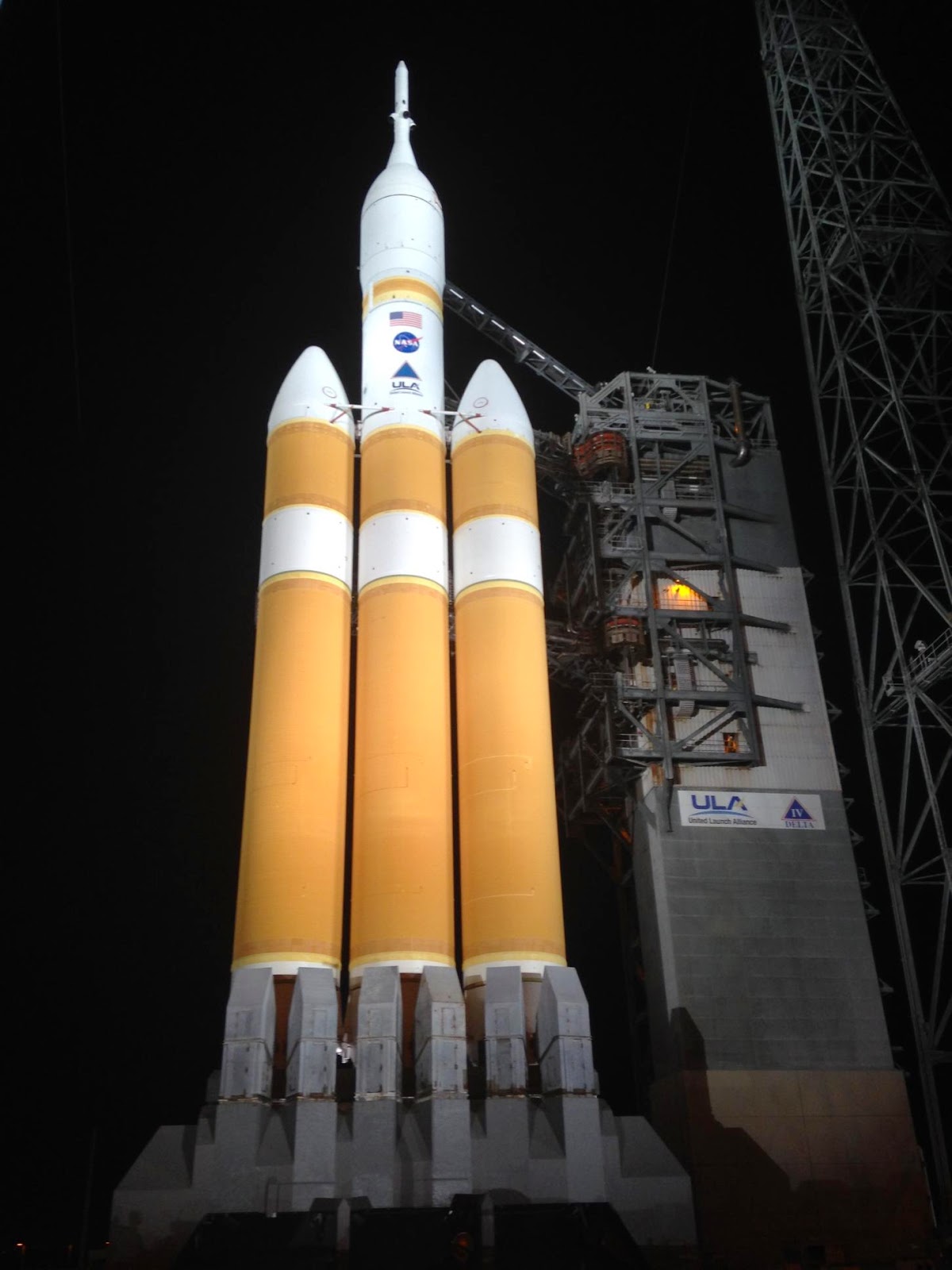
Orion Rising
Flawless launch, flight, re-entry and splash down. Nicely done, NASA. Welcome home. We've missed you.
And, a huge shout-out to United Launch Alliance as well.
Wednesday, December 3, 2014
Thursday, November 20, 2014
Day late and a dollar short
Last week the ESA's Rosetta mission successfully landed the Philae probe onto the surface of Comet 67P/Churyumov–Gerasimenko. Philae bounced several times before finally landing on the side of a cliff. A gentle reminder that for more critical missions which require landing, there is real virtue in having an actual human pilot at the controls.
The total number of bodies in the solar system we have successfully landed anything on intact now stands at seven; the Moon, Venus, Mars, Titan, the asteroids Eros and Itokawa, and comet Chury-Gery. We have returned samples only from the Moon, and asteroid Itokawa.
The next big robotic exploration destination will be when the Dawn spacecraft reaches Ceres next spring. I'm inclined to think that the Dawn Ceres data will be a game-changer in how we prioritize our upcoming human space exploration missions. As such, we'll be following it closely, here.
Friday, November 14, 2014
SCE to AUX
Ice Castles
<p>
This is a previously classified video about the US Army's nuclear powered under-ice facility in Greenland, called Camp Century. It didn't work very well, because the Greenland ice sheets were far more mobile than had been previously understood. But the techniques used here could be adapted to Ceres, Europa, or Enceladus. Note however the enormous logistics that were required to make this happen.
<p>
www.youtube.com/watch?v=1Ujx_pND9wg
Sunday, November 9, 2014
Kung Fu
So, if I translate this for a colonization mission to Mars, in order to build any permanent colony of any size at all (on Mars, or the moon, or really anywhere) then I need my rockets to leave earth, land on Mars, leave Mars and then land back on earth, in more or less the same configuration it took off in. This is reasonable, but unfortunately this is not, to date, the way spaceflight has been able to work.
If we look at the Apollo/Saturn V moon landings as a baseline of the physics needed to send and return humans to and from another world, it is apparent that in order to reach space and return from it, a spacecraft must almost continually shed excess weight. Saturn V stood some two million kilograms on the launch pad, whereas the Apollo command module which ultimately splashed down weighed maybe a thousand kilograms. This is sloppy, expensive and wasteful, but it is the only way to get a payload of this size into space with current technology.
Tsiolkovsky's rocket equation;
in which the weight of the rocket and fuel at the beginning of the launch and at the end of the launch must not exceed the effective exhaust velocity of the rocket. With existing propellants, it is nearly impossible to lift a payload of any real size even to low earth orbit with only a single rocket stage.
So, almost certainly, the first spacecraft to land humans on Mars will be of this Saturn V-type design, either SLS/Orion, or something very much like it. For exploration missions, this is fine, albeit expensive. The advantage is, we already know how to do this. For a colonization mission, the spacecraft are going to need to be much more like a 747, as far as re-useability. Elon Musk is going to want his rockets back, so he can use them again. Simply piling up hardware on the Martian surface, or at the bottom of the Atlantic, is a lousy business model.
SpaceX has already developed a vertical takeoff and landing rocket prototype, called Grasshopper. It is elegant, but burns lots and lots of heavy propellant to be able to control its landings. It is noteworthy that to date, no SpaceX cargo rocket to the ISS has actually utilized this technology, opting instead for multistage rockets and parachute descents. Adding the fuel weight for a Martian descent and surface escape launch, and still having the delta-v to reach orbit, is challenging at best. But necessary, if Martian colonization is going to be available to anybody but the very, very wealthy.
Tuesday, November 4, 2014
To Europa, by Bush-Pilot
According to Chris Bergin at nasaspaceflight.com (probably the best free space blog in the world, and its attendant pay site L2 is without parallel) NASA has padded its newest internal manifest for SLS with flagship robotic missions to Mars and Europa, and single-launch space stations interspersed with Orion crewed missions, in order to boost the launch rate to at least one per year. Taking advantage of SLS's enormous speed for robotic missions to the outer solar system seems a very logical extension of this, and further integrates crewed and uncrewed space exploration into a single, more unified program. For deeper space exploration, the payload capacity to carry space telescopes which could dwarf the James Webb has interesting potential as well. This program is evolving into a deep-space workhorse, analogous to what the space shuttle was supposed to be for Low Earth Orbit. Interesting times.
Friday, October 31, 2014
Through footless halls of air
Virgin Galactic SpaceShipTwo failed today under rocket power, killing one astronaut and seriously injuring another. This is three independent commercial flight failures under rocket power in a month and a half, SpaceX, Orbital and now Virgin. Really, we need to find a better and safer means of getting into space. And now, the pressure on NASA's Orion/EFT-1 flight next month has become enormous.
The test pilot who was killed today has not yet been named in the press, but may he or she rest in peace.
Thursday, October 30, 2014
Orion Rising
The first Orion space capsule is complete, today. The United States of America once again is in possession of a crew-rated spacecraft, the first since the retirement of the space shuttles. In the words of Joe Biden, this is a BFD.
Russian Roulette
The malfunction and then detonation of the Antares/Cygnus cargo spacecraft at Wallops on Tuesday is now being tied to the use of refurbished 1960s Soviet vintage AJ26 rocket engines. I'm not going to speculate on whether or not this is the case; I suspect that the age of the engines had very little to to do with the accident, but I have no evidence to back this up either way.
What is more conclusive is that chemical rockets remain A) the only means we have of launching any payload into low earth orbit and beyond and b) dangerous as hell.
A little bit of sloppy number crunching, looking just at the space shuttle program. Five orbiters totaling some 130 launches, two of which failed catastrophically. That's about a 1.5% failure rate. Scaled up to commercial aircraft, that's about 20 major airline disasters every single day. At Seattle-Tacoma International Airport. By itself.
This is a serious problem for true commercial spaceflight. If the ground crew cheered every time a Boeing 737 took off or landed safely, nobody in their right mind would fly in Boeing 737s. For routine commercial spaceflight to be feasible, we need something which works reliably every time it flies. Highly volatile chemical rockets probably are not the answer.
One possible answer floating around (sorry) is lighter than air craft. The idea of riding a dirigible into space, at first glance, seems a little absurd. But John Powell of JP Aerospace has demonstrated how a hypersonic dirigible could reach the International Space Station, and beyond. Another possibility is using less volatile hybrid (HTPB/N2O "rubber and laughing-gas") rockets, but these have yet to reach the 100 km Kármán line, much less low earth orbit. But better propellants and/or oxidants may be found, which are still reasonably stable. Until then, what we have looks less like science than theology. And if part of your routine flight-plan includes "pray real hard," you're not yet ready to fly grandma to the moon.