Showing posts with label Exobiology. Show all posts
Showing posts with label Exobiology. Show all posts
Thursday, November 22, 2012

Wednesday, November 21, 2012
Curiosity, killing us all

Yesterday, on NPR, NASA dropped a kind of big bomb, maybe.
John Grotzinger, who is the principal investigator for the Mars rover Curiosity mission for JPL, hinted pretty loudly yesterday that Curiosity had made a discovery of monumental importance. But they couldn't talk abut it just yet. The preliminary results from a series of soil samples taken at Rocknest (pictured above) a few weeks ago, if confirmed, will be "one for the history books."
The NPR article is here, for whatever details there are. www.npr.org/2012/11/20/165513016/big-news-from-mars-rover-scientists-mum-for-now
Okay.
So, lots of space blogs are now speculating that Opportunity has discovered (drum roll, please) Life ... On ... MARS!!!(tm).
Again.
So, alright. First off, this wouldn't be the first time that NASA gave a teaser for an announcement that turned out to be something other than the obvious conclusion informed people would likely come to based on the teaser. This isn't even the first time this has happened regarding the possibility of a discovery of life on Mars. It wouldn't even be the first time space blogs, including this one (cough), had made this sort of speculation which later proved wildly erroneous. To their credit, usually the actual announcements are pretty important, just not always as newsworthy to the general public. Remember the arsenic bacteria in Mono Lake? Incredibly important discovery from the standpoint of exobiology, but the average person on the street wasn't likely to care very much. Add to this the sad fact that the NASA budget is very much in the cross-hairs of the Sequestration ("Fiscal Cliff") negotiators, and the possibility that NASA is up to similar shenanigans is not entirely out of the question.
But maybe, just maybe, this is the time that Lucy isn't going to snatch the football away. Maybe.
Okay, let's look at what we actually know here.
Two different laboratories on board Curiosity have now studied soil samples from Rocknest. The first laboratory is called CheMin, which is NASA-ese for Chemistry and Mineralogy. It determines which types of minerals are in a soil sample. The second laboratory, which is the one generating all the excitement, is called SAM, for Sample Analysis at Mars. SAM is designed to analyze the chemical makeup of Martian soil and atmosphere, specifically to determine if there are organic molecules present.
In the past few weeks, these two laboratories have shown that water was once abundant on the surface of Mars (we knew that already, but it was a good confirmation), and that, at least at the sample site, there are not measurable amounts of methane, which on earth is mostly produced by biological processes. What SAM is really looking for is carbon and oxygen, and it has the ability to analyze these using laser spectrometry to determine if the carbon and oxygen it finds is of geological or biological origin.
This is what SAM does. It does not have the ability to directly monitor for metabolic change in the soil chemistry (as the Labeled Release experiment on the Viking missions did back in 1976), but it can and does analyze the basic chemical composition of the soil and atmosphere. Sam has been doing this at Rocknest on Mars for the past several weeks now. And NASA is really, really excited with whatever the preliminary results of that are.
As minimum, one can reasonably conclude that they have in fact found carbon and oxygen which seem to be of biological origin. By itself, that's a pretty big deal, because it would indicate pretty strongly that life of some sort has lived on Mars at some point in its history. That would be an awfully important discovery. But "one for the history books"? Well, yes, for a book about the history of exobiology. But for the average person on the street, probably not all that terribly interesting.
However, and this is purely speculative on my part, if there were really actual living micro-organisms in the soil samples, SAM might detect this as standard ratios of the CHONPS (carbon, hydrogen, oxygen, nitrogen, phosphorus and sulfur) elements which are the signature of life on earth. Or, as a similar ratio of organic chemicals which replace these, such as arsenic apparently does for some amount of phosphorus in the Mono Lake halobacteria. It is possible that this is what NASA has discovered on Mars this week.
And that would unequivocally be one for the history books.
But we wouldn't know anything else about that life. But that's ok, because once we know that there is definitely microbial life in the Martian soil, we have plenty of means to further study it. The most important of these will be genotyping, assuming that any organisms found there actually have genes to type.
There are essentially two possible (hypothetical) outcomes of this. One is that we will find that we share common ancestry with the Martian micro-organisms, either because they originated on earth, or we originated on Mars, or both Martian and terrestrial life originated from someplace else. Any of these are possible. The other outcome is that Martian life arose on Mars completely independently of terrestrial life, either with its own unique DNA or RNA, or else some other truly alien biochemistry. Either of these outcomes could provide tantalizing clues as to the relative ubiquity of life in the universe.
NASA will be announcing the results of the SAM soil experiments in the first week of December, once the data has been verified and re-verified. Until then, the media and blogs like this one are left to their own guesswork. I'll be posting here as soon as anything is known. Until then...
Sunday, August 5, 2012
One small step for robot

Friday, August 3, 2012

Saturday, June 9, 2012
Conan the Bacterium
A couple of months ago I wrote a post entitled "Dune Buggies", about possible microbial life on Mars, and the unlikelihood that such could in any way interact with terrestrial organisms, or vice versa. It turns out, I was not quite correct.
In that post I wrote that "The average surface temperature on Mars is -63° C (-81° F). Rarely, at the equator, temperatures at the very surface reach 20° C (68° F), but even then the temperatures just a few inches above that are sub-arctic. Average barometric pressure on earth is 1013 millibars. Average barometric pressure on Mars is about 6 millibars, which is less than the inside of an early vacuum tube. Martian atmosphere is 95% carbon dioxide, with 210 ppm water vapor. Earth's atmosphere is 78% nitrogen and 21% oxygen, with about 25,000 ppm water vapor at the surface." All of this is true. The implication was that any organism which lived comfortably inside a human being could not possibly survive in that environment.
I was wrong. Meet Deinococcus radiodurans.

It is highly resistant to radiation, dehydration, heat, cold, vacuum, and acid. It can survive being nuked so well that scientists have experimented with encoding information into is DNA to survive a nuclear holocaust (starting, ironically, with Disney's song It's a Small World). In other words, it would survive just fine on the surface of Mars.
Oh, and it lives in our poop.
Polyextremophiles such as D radiodurans could in fact cross-contaminate between terrestrial and martian ecosystems. And this, Houston, could be a problem.
Sunday, April 15, 2012
Dune Buggies
There are in this world a small number of very fortunate people who are able to make an honest and decent living by writing blogs. Good on them, that's an impressive accomplishment. I, on the other hand, have never made a dime writing this blog. Which is fine; this is a hobby for me, and I make my living in other ways which I love and which I think are at least as cool as blogging. However, one of the realities of the fact that I am gainfully employed in the maritime industry is that 1) there are occasionally longish gaps in this blog, some of which occur at times that I might otherwise want to contribute to it and 2) sometimes when I finally am in front of a computer I am unable to find links to news articles and other things which occurred when I did not have access to the internet.
As a rule I try to source anything I post here which I myself do not write. Due to the aforementioned, with apologies, this won't be one of those times.
So. Somewhere in the past week, I saw an article (believe it or not, I don't think it was Fox News this time) discussing the current NASA budget. Specifically it was discussing the fact that prior to landing humans on Mars, we want a robot probe to bring a sample of Martian soil back to earth to analyze for possible microbial life.
This much is essentially true.
However, the article then went on to state that the reason for this is that NASA is concerned that martian microbes might bear disease which could infect human explorers.
Oh dear.
I am, for the record, not a biologist, so perhaps my understanding of such things is too limited. But it seems to me rather unlikely that an organism which has evolved over millions of years to thrive on a parched, frozen and nearly airless world would find the warm, wet interior of a human body a very hospitable place.
On earth, disease organisms tend to be very host-species specific, and co-evolutionary with their hosts. There are a few diseases such as rabies which are transmissible between different mammals, and still fewer diseases which are transmissible between endothermic vertebrates (such as avian influenza). But this is not the general rule. Veterinarians do not need to be nearly so cautious about fluid-borne pathogens as their human-medicine counterparts, for this very reason.
Even more rare on earth are pathogens which are not transmitted by other organisms, but rather directly from the environment. Amoebic dysentery is an example of this, where a prokaryote which thrives in warm, still water also happens to thrive, unsurprisingly, in the human body. Trichophyton (athlete's foot, ringworm etc) and other fungal infections also require warm, wet environments.
Similarly, on earth there have been many examples of organisms from one region being introduced into a different region and thriving, even in some cases out-competing native organisms of similar niches. One of the most extreme examples of this is kudzu, an ornamental ivy from Japan which now threatens to eradicate most of the US states in the southeast (although probably not quickly enough to have any beneficial effect on the 2012 elections). Again, the new temperate environment was only slightly different from the old temperate environment.
When we relocate species from their native environment to a radically different one, even within the same climatological zone, we find a very different outcome. Consider two terrestrial vertebrate apex-predators, the Bengal tiger and the great white shark. A healthy adult great white shark deposited in the grasslands below the Himalayas is probably not going to successfully out-compete the native tigers. Similarly, a healthy adult Bengal tiger relocated to the middle of the Indian ocean is not going to seriously impinge upon the shark's hunting grounds. And yet, these two environments are remarkably similar, in terms of temperature, humidity, barometric pressure, gravity, environmental chemistry, solar and cosmic radiation; even the length of the day and year are similar. More importantly, the organisms themselves are remarkably similar. Form does, after all, follow function, and they also have a common evolutionary ancestor. And yet, neither can survive for more than a few minutes in the other's native habitat.
Now, consider Mars.
The average surface temperature on Mars is -63° C (-81° F). Rarely, at the equator, temperatures at the very surface reach 20° C (68° F), but even then the temperatures just a few inches above that are sub-arctic. Average barometric pressure on earth is 1013 millibars. Average barometric pressure on Mars is about 6 millibars, which is less than the inside of an early vacuum tube. Martian atmosphere is 95% carbon dioxide, with 210 ppm water vapor. Earth's atmosphere is 78% nitrogen and 21% oxygen, with about 25,000 ppm water vapor at the surface.
Martian life, if such exists, cannot survive in earth's atmosphere, or within the bodies of organisms which evolved within that atmosphere. Just as importantly, terrestrial organisms cannot survive on Mars. In the case of Mars, we do not need a "microbial Prime Directive". We could bombard Mars with terrestrial bacteria for weeks, and within minutes of their landing on the Martian surface they would all be dead and frozen. Similarly, we do not need to worry about an "Andromeda Strain" being returned from Mars to earth. The greatest difficulty will be keeping any organisms alive long enough to study them.
Wednesday, November 16, 2011
Europa back in the game
NASA announced today the presence of enormous salt-water lakes only several kilometers below the surface ice of Jupiter's moon Europa. From the standpoint of colonization (and also incidentally exobiology), this is vastly preferable to the ocean of salt-water which also exists on Europa, but at some 100 kilometers below the surface ice. This puts Europa back in the running as a plausible candidate for outmigration, and possibly even in the top tier.
With this data, the three best candidates for a permanent and self-sustaining colony are, arguably, Ceres, Europa and Enceladus.
Saturn's moon Enceladus is in some ways the most appealing, but by far the least accessible. At 1.5 BILLION kilometers, it is more than twice the distance to Jupiter/Europa, and six times the distance to Ceres. And it is the smallest of the three candidates. But essentially limitless supplies of water and energy are relatively accessible to anyone living on the surface, and from the standpoint of self-sustainability that's huge.
Europa now meets most of the same criteria, is six times larger than Enceladus (and just a bit smaller than our own moon), and is much closer. The biggest drawback with Europa is still the very high amounts of ionizing radiation from Jupiter that would be experienced on the surface. Burrowing under the ice would provide shielding, but you have to get down there first. It is also possible that we could use another of the Galilean moons such as Callisto as a base-camp while drilling down to to the Europan lakes.
Dwarf planet Ceres is practically in our own backyard, and about twice the size of Enceladus. It too is covered with water ice over a salt-water ocean, but we don't know yet how thick that ice-mantle is. When the Dawn spacecraft arrives there in 2015 we'll know a lot more. Ceres receives ample sunlight for solar power, so even if there were no geothermal energy such as on Europa, or whatever-the-hell is generating 16 gigawatts of energy on Enceladus, it could probably support a substantial colony even if the surface ice had to be melted for water. At this time, I'm inclined to think that Ceres may be our best shot at getting a permanent and self-sustaining colony established quickly, but we'll know a lot more once the Dawn spacecraft starts sending back data.
Many people have speculated that Ceres would be an important stepping-stone for colonization of the outer planets, but she may prove to be a critical destination in her own right.
With this data, the three best candidates for a permanent and self-sustaining colony are, arguably, Ceres, Europa and Enceladus.
Saturn's moon Enceladus is in some ways the most appealing, but by far the least accessible. At 1.5 BILLION kilometers, it is more than twice the distance to Jupiter/Europa, and six times the distance to Ceres. And it is the smallest of the three candidates. But essentially limitless supplies of water and energy are relatively accessible to anyone living on the surface, and from the standpoint of self-sustainability that's huge.
Europa now meets most of the same criteria, is six times larger than Enceladus (and just a bit smaller than our own moon), and is much closer. The biggest drawback with Europa is still the very high amounts of ionizing radiation from Jupiter that would be experienced on the surface. Burrowing under the ice would provide shielding, but you have to get down there first. It is also possible that we could use another of the Galilean moons such as Callisto as a base-camp while drilling down to to the Europan lakes.
Dwarf planet Ceres is practically in our own backyard, and about twice the size of Enceladus. It too is covered with water ice over a salt-water ocean, but we don't know yet how thick that ice-mantle is. When the Dawn spacecraft arrives there in 2015 we'll know a lot more. Ceres receives ample sunlight for solar power, so even if there were no geothermal energy such as on Europa, or whatever-the-hell is generating 16 gigawatts of energy on Enceladus, it could probably support a substantial colony even if the surface ice had to be melted for water. At this time, I'm inclined to think that Ceres may be our best shot at getting a permanent and self-sustaining colony established quickly, but we'll know a lot more once the Dawn spacecraft starts sending back data.
Many people have speculated that Ceres would be an important stepping-stone for colonization of the outer planets, but she may prove to be a critical destination in her own right.
Thursday, August 4, 2011
Waterfalls on Barsoom
NASA today released photos of what is very likely brine flowing, in not insignificant amounts, down the side of an equatorial crater on Mars.
From the standpoint of human outmigration and colonization, this isn't exactly a game-changer. We've known for a while that there is a large amount of frozen water at or near the surface of Mars. We've also known for a while that Mars has equatorial surface temperatures as high as 27°C (81°F, which here in Seattle is referred to as a heat-wave), albeit only for a few centimeters above the ground. So it would probably be more unusual if these did not result in Mars having occasional surface water. With a surface atmospheric pressure of some 6 millibars (compared to Earth's average of 1013 mb) we wouldn't expect any surface water to last very long, and the fact that the "surface" water detected appears to be actually embedded in sand or dust is pretty much what we should expect. But for human colonists, this water would not be very much easier (and possibly rather more difficult) to extract and utilize than the near-surface ice which is much more abundant.
On the other hand, from the standpoint of exobiology, this is huge. Because it means that we are officially no longer just searching for fossils of Martian life. It is now genuinely reasonable to imagine that we will find life there, at least in microbial form. Not on the Martian surface, where cosmic and solar radiation would almost certainly sterilize anything possessing anything resembling RNA or DNA. But in the sub-martian aquifers which are necessarily feeding these springs, life may well have survived from a time when Mars was far more hospitable to life as it exists on Earth.
In the search for life on Mars, we now have a definitive starting point.

NASA Spacecraft Data Suggest Water Flowing on Mars
PASADENA, Calif. -- Observations from NASA's Mars Reconnaissance Orbiter have revealed possible flowing water during the warmest months on Mars.
"NASA's Mars Exploration Program keeps bringing us closer to determining whether the Red Planet could harbor life in some form,” NASA Administrator Charles Bolden said, “and it reaffirms Mars as an important future destination for human exploration."
Dark, finger-like features appear and extend down some Martian slopes during late spring through summer, fade in winter, and return during the next spring. Repeated observations have tracked the seasonal changes in these recurring features on several steep slopes in the middle latitudes of Mars' southern hemisphere.
"The best explanation for these observations so far is the flow of briny water," said Alfred McEwen of the University of Arizona, Tucson. McEwen is the principal investigator for the orbiter's High Resolution Imaging Science Experiment (HiRISE) and lead author of a report about the recurring flows published in Thursday's edition of the journal Science.
Some aspects of the observations still puzzle researchers, but flows of liquid brine fit the features' characteristics better than alternate hypotheses. Saltiness lowers the freezing temperature of water. Sites with active flows get warm enough, even in the shallow subsurface, to sustain liquid water that is about as salty as Earth's oceans, while pure water would freeze at the observed temperatures.
"These dark lineations are different from other types of features on Martian slopes," said Mars Reconnaissance Orbiter Project Scientist Richard Zurek of NASA's Jet Propulsion Laboratory in Pasadena, Calif. "Repeated observations show they extend ever farther downhill with time during the warm season."
The features imaged are only about 0.5 to 5 yards or meters wide, with lengths up to hundreds of yards. The width is much narrower than previously reported gullies on Martian slopes. However, some of those locations display more than 1,000 individual flows. Also, while gullies are abundant on cold, pole-facing slopes, these dark flows are on warmer, equator-facing slopes.
The images show flows lengthen and darken on rocky equator-facing slopes from late spring to early fall. The seasonality, latitude distribution and brightness changes suggest a volatile material is involved, but there is no direct detection of one. The settings are too warm for carbon-dioxide frost and, at some sites, too cold for pure water. This suggests the action of brines, which have lower freezing points. Salt deposits over much of Mars indicate brines were abundant in Mars' past. These recent observations suggest brines still may form near the surface today in limited times and places.
When researchers checked flow-marked slopes with the orbiter's Compact Reconnaissance Imaging Spectrometer for Mars (CRISM), no sign of water appeared. The features may quickly dry on the surface or could be shallow subsurface flows.
"The flows are not dark because of being wet," McEwen said. "They are dark for some other reason."
A flow initiated by briny water could rearrange grains or change surface roughness in a way that darkens the appearance. How the features brighten again when temperatures drop is harder to explain.
"It's a mystery now, but I think it's a solvable mystery with further observations and laboratory experiments," McEwen said.
These results are the closest scientists have come to finding evidence of liquid water on the planet's surface today. Frozen water, however has been detected near the surface in many middle to high-latitude regions. Fresh-looking gullies suggest slope movements in geologically recent times, perhaps aided by water. Purported droplets of brine also appeared on struts of the Phoenix Mars Lander. If further study of the recurring dark flows supports evidence of brines, these could be the first known Martian locations with liquid water.
From the standpoint of human outmigration and colonization, this isn't exactly a game-changer. We've known for a while that there is a large amount of frozen water at or near the surface of Mars. We've also known for a while that Mars has equatorial surface temperatures as high as 27°C (81°F, which here in Seattle is referred to as a heat-wave), albeit only for a few centimeters above the ground. So it would probably be more unusual if these did not result in Mars having occasional surface water. With a surface atmospheric pressure of some 6 millibars (compared to Earth's average of 1013 mb) we wouldn't expect any surface water to last very long, and the fact that the "surface" water detected appears to be actually embedded in sand or dust is pretty much what we should expect. But for human colonists, this water would not be very much easier (and possibly rather more difficult) to extract and utilize than the near-surface ice which is much more abundant.
On the other hand, from the standpoint of exobiology, this is huge. Because it means that we are officially no longer just searching for fossils of Martian life. It is now genuinely reasonable to imagine that we will find life there, at least in microbial form. Not on the Martian surface, where cosmic and solar radiation would almost certainly sterilize anything possessing anything resembling RNA or DNA. But in the sub-martian aquifers which are necessarily feeding these springs, life may well have survived from a time when Mars was far more hospitable to life as it exists on Earth.
In the search for life on Mars, we now have a definitive starting point.
NASA Spacecraft Data Suggest Water Flowing on Mars
PASADENA, Calif. -- Observations from NASA's Mars Reconnaissance Orbiter have revealed possible flowing water during the warmest months on Mars.
"NASA's Mars Exploration Program keeps bringing us closer to determining whether the Red Planet could harbor life in some form,” NASA Administrator Charles Bolden said, “and it reaffirms Mars as an important future destination for human exploration."
Dark, finger-like features appear and extend down some Martian slopes during late spring through summer, fade in winter, and return during the next spring. Repeated observations have tracked the seasonal changes in these recurring features on several steep slopes in the middle latitudes of Mars' southern hemisphere.
"The best explanation for these observations so far is the flow of briny water," said Alfred McEwen of the University of Arizona, Tucson. McEwen is the principal investigator for the orbiter's High Resolution Imaging Science Experiment (HiRISE) and lead author of a report about the recurring flows published in Thursday's edition of the journal Science.
Some aspects of the observations still puzzle researchers, but flows of liquid brine fit the features' characteristics better than alternate hypotheses. Saltiness lowers the freezing temperature of water. Sites with active flows get warm enough, even in the shallow subsurface, to sustain liquid water that is about as salty as Earth's oceans, while pure water would freeze at the observed temperatures.
"These dark lineations are different from other types of features on Martian slopes," said Mars Reconnaissance Orbiter Project Scientist Richard Zurek of NASA's Jet Propulsion Laboratory in Pasadena, Calif. "Repeated observations show they extend ever farther downhill with time during the warm season."
The features imaged are only about 0.5 to 5 yards or meters wide, with lengths up to hundreds of yards. The width is much narrower than previously reported gullies on Martian slopes. However, some of those locations display more than 1,000 individual flows. Also, while gullies are abundant on cold, pole-facing slopes, these dark flows are on warmer, equator-facing slopes.
The images show flows lengthen and darken on rocky equator-facing slopes from late spring to early fall. The seasonality, latitude distribution and brightness changes suggest a volatile material is involved, but there is no direct detection of one. The settings are too warm for carbon-dioxide frost and, at some sites, too cold for pure water. This suggests the action of brines, which have lower freezing points. Salt deposits over much of Mars indicate brines were abundant in Mars' past. These recent observations suggest brines still may form near the surface today in limited times and places.
When researchers checked flow-marked slopes with the orbiter's Compact Reconnaissance Imaging Spectrometer for Mars (CRISM), no sign of water appeared. The features may quickly dry on the surface or could be shallow subsurface flows.
"The flows are not dark because of being wet," McEwen said. "They are dark for some other reason."
A flow initiated by briny water could rearrange grains or change surface roughness in a way that darkens the appearance. How the features brighten again when temperatures drop is harder to explain.
"It's a mystery now, but I think it's a solvable mystery with further observations and laboratory experiments," McEwen said.
These results are the closest scientists have come to finding evidence of liquid water on the planet's surface today. Frozen water, however has been detected near the surface in many middle to high-latitude regions. Fresh-looking gullies suggest slope movements in geologically recent times, perhaps aided by water. Purported droplets of brine also appeared on struts of the Phoenix Mars Lander. If further study of the recurring dark flows supports evidence of brines, these could be the first known Martian locations with liquid water.
Monday, June 13, 2011
Rocks and Buggys
The best direct evidence we have to date of extraterrestrial life is in the form of microscopic inclusions in a small number of carbonaceous meteorites, which have the appearance of being fossilized prokaryotes. By far the best known of these is ALH 84001, the martian meteorite found in Allan Hills Antarctica in 1984.
Earlier this year NASAjavascript:void(0)/Huntsville scientist Richard Hoover announced that a number of non-martian meteorites also contain possible fossil prokaryotes. Below is both his abstract and a link to the entire paper in Journal of Cosmology.

Okay. So, I happen to like JoC. It's one of the many links from this blog, and I really like their philosophy of ensuring that all of the papers they publish are available to anyone free of charge. Most similar outlets only publish the abstracts free of charge. So, good on them for this. And good on them for maintaining some semblance of a peer-review process.
The bad news with JoC is that they have a very openly anti-scientific agenda, which tends to lead to the occasional publication of some really, really shoddy research. Regarding Hoover's work, they state that "Hoover's paper is further evidence that life is pervasive in this galaxy and exists on astral bodies other than Earth. The alternative view is life exists only on Earth, and originated on Earth, as described in the Jewish and Christian Bible and which is the official position at NASA. We believe the choice is simple: Religion vs Science. The Journal of Cosmology is devoted to promoting science."
This philosophy steers many of the papers published in JoC. Up to and including denying the Big Bang, not on the basis of any solid evidence but rather on the basis that it looks a little bit like Genesis and that Georges Lemaître happened to be a Catholic priest. Really. Presumably gene theory is also not "science" as JoC imagines that, because Gregor Mendel was an Augustinian monk.
JoC is in no way unique in this. Capital "S" Science, like capital "A" Atheism, is simply another fundamentalist religion, with its own canon world-views and orthodoxies and hence necessary heresies. It has adopted the old fundamentalist Christian mantra of "don't open your mind, your brains might leak out"; I consider "Science" to be one of the greatest threats to rational critical thought, and legitimate science, in our culture today.
Just because the Bible says something doesn't mean that it's categorically true. Just because the Bible says something also doesn't mean that it's categorically untrue. It's just a freaking book.
I'm not sure why Richard Hoover, a respected NASA scientist, did not publish his research through NASA, and instead published through the Journal of Cosmology. It doesn't exactly help his credibility. For the record, I think he's mostly right, and that NASA would have published his work, so I can only assume that his decision not to was political rather than scientific.
In any event, here is his paper. The entire thing is linked at the bottom.
==========================================================
Fossils of Cyanobacteria in CI1 Carbonaceous Meteorites:
Implications to Life on Comets, Europa, and Enceladus
Richard B. Hoover,
Space Science Office, Mail Code 62, NASA/Marshall Space Flight Center, Huntsville, AL 35812
Abstract
Environmental (ESEM) and Field Emission Scanning Electron Microscopy (FESEM) investigations of the internal surfaces of the CI1 Carbonaceous Meteorites have yielded images of large complex filaments. The filaments have been observed to be embedded in freshly fractured internal surfaces of the stones. They exhibit features (e.g., the size and size ranges of the internal cells and their location and arrangement within sheaths) that are diagnostic of known genera and species of trichomic cyanobacteria and other trichomic prokaryotes such as the filamentous sulfur bacteria. ESEM and FESEM studies of living and fossil cyanobacteria show similar features in uniseriate and multiseriate, branched or unbranched, isodiametric or tapered, polarized or unpolarized filaments with trichomes encased within thin or thick external sheaths. Filaments found in the CI1 meteorites have also been detected that exhibit structures consistent with the specialized cells and structures used by cyanobacteria for reproduction (baeocytes, akinetes and hormogonia), nitrogen fixation (basal, intercalary or apical heterocysts) and attachment or motility (fimbriae). Energy dispersive X-ray Spectroscopy (EDS) studies indicate that the meteorite filaments are typically carbon rich sheaths infilled with magnesium sulfate and other minerals characteristic of the CI1 carbonaceous meteorites. The size, structure, detailed morphological characteristics and chemical compositions of the meteorite filaments are not consistent with known species of minerals. The nitrogen content of the meteorite filaments are almost always below the detection limit of the EDS detector. EDS analysis of terrestrial minerals and biological materials (e.g., fibrous epsomite, filamentous cyanobacteria; mummy and mammoth hair/tissues, and fossils of cyanobacteria, trilobites, insects in amber) indicate that nitrogen remains detectable in biological materials for thousands of years but is undetectable in the ancient fossils. These studies have led to the conclusion that the filaments found in the CI1 carbonaceous meteorites are indigenous fossils rather than modern terrestrial biological contaminants that entered the meteorites after arrival on Earth. The δ13C and D/H content of amino acids and other organics found in these stones are shown to be consistent with the interpretation that comets represent the parent bodies of the CI1 carbonaceous meteorites. The implications of the detection of fossils of cyanobacteria in the CI1 meteorites to the possibility of life on comets, Europa and Enceladus are discussed. Keywords: Origins of life, CI1 meteorites, Orgueil, Alais Ivuna, microfossils, cyanobacteria, comets, Europa, Enceladus
http://journalofcosmology.com/Life100.html
Earlier this year NASAjavascript:void(0)/Huntsville scientist Richard Hoover announced that a number of non-martian meteorites also contain possible fossil prokaryotes. Below is both his abstract and a link to the entire paper in Journal of Cosmology.

Okay. So, I happen to like JoC. It's one of the many links from this blog, and I really like their philosophy of ensuring that all of the papers they publish are available to anyone free of charge. Most similar outlets only publish the abstracts free of charge. So, good on them for this. And good on them for maintaining some semblance of a peer-review process.
The bad news with JoC is that they have a very openly anti-scientific agenda, which tends to lead to the occasional publication of some really, really shoddy research. Regarding Hoover's work, they state that "Hoover's paper is further evidence that life is pervasive in this galaxy and exists on astral bodies other than Earth. The alternative view is life exists only on Earth, and originated on Earth, as described in the Jewish and Christian Bible and which is the official position at NASA. We believe the choice is simple: Religion vs Science. The Journal of Cosmology is devoted to promoting science."
This philosophy steers many of the papers published in JoC. Up to and including denying the Big Bang, not on the basis of any solid evidence but rather on the basis that it looks a little bit like Genesis and that Georges Lemaître happened to be a Catholic priest. Really. Presumably gene theory is also not "science" as JoC imagines that, because Gregor Mendel was an Augustinian monk.
JoC is in no way unique in this. Capital "S" Science, like capital "A" Atheism, is simply another fundamentalist religion, with its own canon world-views and orthodoxies and hence necessary heresies. It has adopted the old fundamentalist Christian mantra of "don't open your mind, your brains might leak out"; I consider "Science" to be one of the greatest threats to rational critical thought, and legitimate science, in our culture today.
Just because the Bible says something doesn't mean that it's categorically true. Just because the Bible says something also doesn't mean that it's categorically untrue. It's just a freaking book.
I'm not sure why Richard Hoover, a respected NASA scientist, did not publish his research through NASA, and instead published through the Journal of Cosmology. It doesn't exactly help his credibility. For the record, I think he's mostly right, and that NASA would have published his work, so I can only assume that his decision not to was political rather than scientific.
In any event, here is his paper. The entire thing is linked at the bottom.
==========================================================
Fossils of Cyanobacteria in CI1 Carbonaceous Meteorites:
Implications to Life on Comets, Europa, and Enceladus
Richard B. Hoover,
Space Science Office, Mail Code 62, NASA/Marshall Space Flight Center, Huntsville, AL 35812
Abstract
Environmental (ESEM) and Field Emission Scanning Electron Microscopy (FESEM) investigations of the internal surfaces of the CI1 Carbonaceous Meteorites have yielded images of large complex filaments. The filaments have been observed to be embedded in freshly fractured internal surfaces of the stones. They exhibit features (e.g., the size and size ranges of the internal cells and their location and arrangement within sheaths) that are diagnostic of known genera and species of trichomic cyanobacteria and other trichomic prokaryotes such as the filamentous sulfur bacteria. ESEM and FESEM studies of living and fossil cyanobacteria show similar features in uniseriate and multiseriate, branched or unbranched, isodiametric or tapered, polarized or unpolarized filaments with trichomes encased within thin or thick external sheaths. Filaments found in the CI1 meteorites have also been detected that exhibit structures consistent with the specialized cells and structures used by cyanobacteria for reproduction (baeocytes, akinetes and hormogonia), nitrogen fixation (basal, intercalary or apical heterocysts) and attachment or motility (fimbriae). Energy dispersive X-ray Spectroscopy (EDS) studies indicate that the meteorite filaments are typically carbon rich sheaths infilled with magnesium sulfate and other minerals characteristic of the CI1 carbonaceous meteorites. The size, structure, detailed morphological characteristics and chemical compositions of the meteorite filaments are not consistent with known species of minerals. The nitrogen content of the meteorite filaments are almost always below the detection limit of the EDS detector. EDS analysis of terrestrial minerals and biological materials (e.g., fibrous epsomite, filamentous cyanobacteria; mummy and mammoth hair/tissues, and fossils of cyanobacteria, trilobites, insects in amber) indicate that nitrogen remains detectable in biological materials for thousands of years but is undetectable in the ancient fossils. These studies have led to the conclusion that the filaments found in the CI1 carbonaceous meteorites are indigenous fossils rather than modern terrestrial biological contaminants that entered the meteorites after arrival on Earth. The δ13C and D/H content of amino acids and other organics found in these stones are shown to be consistent with the interpretation that comets represent the parent bodies of the CI1 carbonaceous meteorites. The implications of the detection of fossils of cyanobacteria in the CI1 meteorites to the possibility of life on comets, Europa and Enceladus are discussed. Keywords: Origins of life, CI1 meteorites, Orgueil, Alais Ivuna, microfossils, cyanobacteria, comets, Europa, Enceladus
http://journalofcosmology.com/Life100.html
Thursday, June 2, 2011
Genesis
The question of how life originally arose on earth is of particular significance both to those searching for extraterrestrial life and to those searching for habitable worlds which are devoid of life.
Mythology withstanding, there are four likely possibilities of how life first arose on earth.
The first is anomalous abiogenesis, meaning that life arose from non-life in a single instance, and that all life on earth descended from that unique prototypical life form.
The second is non-anomalous abiogenesis, meaning that when the conditions are correct life tends to occur spontaneously and ubiquitously. In this case, the two existing domains of prokaryotes (bacteria and archae) were of completely different abiogenetic origin, and presumably other independent forms of prokaryotic life existed at one time but were out-competed early in earth's prehistory.
The third and fourth are anomalous and non-anomalous panspermia. This is the idea that prokaryotic life arrived on earth from space, likely ensconced in meteorites. There is a substantial amount of material support for this theory, which this series will explore in some detail. Panspermia does not answer the the question of how life originated in the first place, but for our purposes that concern is frankly secondary.
It is also of course possible that terrestrial life arose both on earth and from space. But determining which contemporary organisms are native and which are descended from aliens may not be knowable until we have unequivocally extraterrestrial organisms to compare them to.
The essence of this question is simply this: how rare or ubiquitous is life in our solar system and beyond? And if life beyond our atmosphere is not rare, how exotic or mundane is that life? We are now, possibly, starting to have some answers to these questions. These answers, and their implications, will be the subject of the next several posts.
===================
Regarding the next week or so of posting, I will be out of the state and away from any real computer for much of the next week. Will post as much as possible via Android phone; many apologies in advance for the typos. There will be many.
Mythology withstanding, there are four likely possibilities of how life first arose on earth.
The first is anomalous abiogenesis, meaning that life arose from non-life in a single instance, and that all life on earth descended from that unique prototypical life form.
The second is non-anomalous abiogenesis, meaning that when the conditions are correct life tends to occur spontaneously and ubiquitously. In this case, the two existing domains of prokaryotes (bacteria and archae) were of completely different abiogenetic origin, and presumably other independent forms of prokaryotic life existed at one time but were out-competed early in earth's prehistory.
The third and fourth are anomalous and non-anomalous panspermia. This is the idea that prokaryotic life arrived on earth from space, likely ensconced in meteorites. There is a substantial amount of material support for this theory, which this series will explore in some detail. Panspermia does not answer the the question of how life originated in the first place, but for our purposes that concern is frankly secondary.
It is also of course possible that terrestrial life arose both on earth and from space. But determining which contemporary organisms are native and which are descended from aliens may not be knowable until we have unequivocally extraterrestrial organisms to compare them to.
The essence of this question is simply this: how rare or ubiquitous is life in our solar system and beyond? And if life beyond our atmosphere is not rare, how exotic or mundane is that life? We are now, possibly, starting to have some answers to these questions. These answers, and their implications, will be the subject of the next several posts.
===================
Regarding the next week or so of posting, I will be out of the state and away from any real computer for much of the next week. Will post as much as possible via Android phone; many apologies in advance for the typos. There will be many.
Wednesday, June 1, 2011
Ready about
So, here's where things stand with the discussion of Orion, DARPA's "100 year starship".
We currently have the technology to build a ship which could reach Alpha Centauri in 88 years.
In the context of this series on outmigration, our primary purpose in doing so is to migrate some small portion of the human gene pool off-world, to enhance the possibility of our continued survival as a species. This seems to be one of DARPA's purposes as well.
In order for Alpha Centauri to actually warrant traveling to it, we would need to know beforehand that a world exists in that system which is significantly more hospitable than Mars or other locations in our solar system, but devoid of life.
We will likely have the ability to determine this with some confidence in the coming decade. The existence or non-existence of an earth-sized world with a significant amount of liquid water on its surface will probably be known within the next few years, assuming that the Exo-Earth Imager telescope is completed.

If no such world is found, then the search would shift to Barnard's Star. If Barnard's Star proved similarly devoid of habitable worlds, Orion will almost certainly not be built. At least, not the interstellar version of Orion. There would simply be no point.
Assuming that a suitable world is found, determining the existence of life will prove more challenging, but high concentrations of atmospheric oxygen or methane on a temperate world would be a pretty good first clue. If we should find conclusive evidence of life on such a world, that would immediately shift the focus away from colonization toward very cautious exploration. Because a war of the worlds, even unintentional and even on a microbial scale, is likely to end badly for everyone involved.
If our hypothetical "goldilocks world" should prove mostly habitable but uninhabited, the first priority of the new colonists will be terraforming it from "mostly habitable" to truly earth-like. By definition, any world worthy of traveling four lightyears to terraform should be pretty quick and simple to terraform. A need for much more than simple oxygenation of the atmosphere (by photosynthetic or chemical means) would tip the balance back in favor of Mars or Europa for permanent colonization. But we cannot begin to estimate what steps would be necessary for terraformation until we have a pretty good understanding of the world as it currently exists. And until we know those steps, and what resources we can hope to find on that world to help accomplish those steps, we have no way of determining how much of the cargo space of the Orion vessel would be committed to carrying either materiel for terraformation, or equipment for surviving on a non-terraformed world.
This brings us to something of an impasse. We have the technology and resources to build the working parts of Orion. But we do not yet have the knowledge to determine what to carry in it, and for a one-way sojourn to the nearest stars, we cannot leave that to guesswork. Until the Exo-Earth Imager is operational, and we have real data about the planetary systems of Alpha Centauri and Barnard's Star, we cannot proceed much further on this tack.
The good news is, if all goes well we may have the answers we need much sooner than we would realistically begin building Orion.
In the mean time, we have left an enormous question unanswered which is critical for human colonization not only of the stars, but of the other worlds within our own solar system. Our quest for a habitable-but-uninhabited world raises the question of how in fact life arises on a world, and how common this process actually is. So I want to take this discussion on a different tack for a bit, and look at how life arose on earth, and how likely it is that life has arisen elsewhere. For the next several posts I'm going to look at abiogenesis, panspermia, and exobiology generally.
Helm's a lee.
We currently have the technology to build a ship which could reach Alpha Centauri in 88 years.
In the context of this series on outmigration, our primary purpose in doing so is to migrate some small portion of the human gene pool off-world, to enhance the possibility of our continued survival as a species. This seems to be one of DARPA's purposes as well.
In order for Alpha Centauri to actually warrant traveling to it, we would need to know beforehand that a world exists in that system which is significantly more hospitable than Mars or other locations in our solar system, but devoid of life.
We will likely have the ability to determine this with some confidence in the coming decade. The existence or non-existence of an earth-sized world with a significant amount of liquid water on its surface will probably be known within the next few years, assuming that the Exo-Earth Imager telescope is completed.
If no such world is found, then the search would shift to Barnard's Star. If Barnard's Star proved similarly devoid of habitable worlds, Orion will almost certainly not be built. At least, not the interstellar version of Orion. There would simply be no point.
Assuming that a suitable world is found, determining the existence of life will prove more challenging, but high concentrations of atmospheric oxygen or methane on a temperate world would be a pretty good first clue. If we should find conclusive evidence of life on such a world, that would immediately shift the focus away from colonization toward very cautious exploration. Because a war of the worlds, even unintentional and even on a microbial scale, is likely to end badly for everyone involved.
If our hypothetical "goldilocks world" should prove mostly habitable but uninhabited, the first priority of the new colonists will be terraforming it from "mostly habitable" to truly earth-like. By definition, any world worthy of traveling four lightyears to terraform should be pretty quick and simple to terraform. A need for much more than simple oxygenation of the atmosphere (by photosynthetic or chemical means) would tip the balance back in favor of Mars or Europa for permanent colonization. But we cannot begin to estimate what steps would be necessary for terraformation until we have a pretty good understanding of the world as it currently exists. And until we know those steps, and what resources we can hope to find on that world to help accomplish those steps, we have no way of determining how much of the cargo space of the Orion vessel would be committed to carrying either materiel for terraformation, or equipment for surviving on a non-terraformed world.
This brings us to something of an impasse. We have the technology and resources to build the working parts of Orion. But we do not yet have the knowledge to determine what to carry in it, and for a one-way sojourn to the nearest stars, we cannot leave that to guesswork. Until the Exo-Earth Imager is operational, and we have real data about the planetary systems of Alpha Centauri and Barnard's Star, we cannot proceed much further on this tack.
The good news is, if all goes well we may have the answers we need much sooner than we would realistically begin building Orion.
In the mean time, we have left an enormous question unanswered which is critical for human colonization not only of the stars, but of the other worlds within our own solar system. Our quest for a habitable-but-uninhabited world raises the question of how in fact life arises on a world, and how common this process actually is. So I want to take this discussion on a different tack for a bit, and look at how life arose on earth, and how likely it is that life has arisen elsewhere. For the next several posts I'm going to look at abiogenesis, panspermia, and exobiology generally.
Helm's a lee.
Sunday, January 9, 2011
Drill Close to Reaching 14-Million-Year-Old Antarctic Lake
There are some significant differences between Lake Vostok and Europa; for example, we have no evidence of hydrothermal vents at the bottom of Vostok. That said, whatever is found at the bottom of the Vostok ice glacier will have very interesting implications for the search for life on Europa and Enceladus.
 WIRED UK-- Lake Vostok, which has been sealed off from the world for 14 million years, is about to be penetrated by a Russian drill bit.
The lake, which lies 2.5 miles below the icy surface of Antarctica, is unique in that it’s been completely isolated from the other 150 subglacial lakes on the continent for such a long time. It’s also oligotropic, meaning that it’s supersaturated with oxygen: Levels of the element are 50 times higher than those found in most typical freshwater lakes.
Since 1990, the Arctic and Antarctic Research Institute in St. Petersburg in Russia has been drilling through the ice to reach the lake, but fears of contamination of the ecosystem in the lake have stopped the process multiple times, most notably in 1998 when the drills were turned off for almost eight years.
Now, the team has satisfied the Antarctic Treaty Secretariat, which safeguards the continent’s environment, that it’s come up with a technique to sample the lake without contaminating it. Valery Lukin told New Scientist: “Once the lake is reached, the water pressure will push the working body and the drilling fluid upwards in the borehole, and then freeze again.” The next season, the team will bore into that frozen water to recover a sample whose contents can then be analysed.
The drill bit currently sits less than 328 feet above the lake. Once it reaches 65 to 98 feet, the mechanical drill bit will be replaced with a thermal lance that’s equipped with a camera.
Time is short, however. It’s possible that the drillers won’t be able to reach the water before the end of the current Antarctic summer , and they’ll need to wait another year before the process can continue.
When the sample can be recovered, however, it’s hoped that it’ll shed light on extremophiles — lifeforms that survive in extreme environments. Life in Lake Vostok would need adaptions to the oxygen-rich environment, which could include high concentrations of protective enzymes. The conditions in Lake Vostok are very similar to the conditions on Jupiter’s moon Europa and Saturn’s moon Enceladus, so the new data could also strengthen the case for extraterrestrial life.
Finally, anything living in the lake will have evolved in relative isolation for about 14 million years, so it could offer a snapshot of conditions on earth long before humans evolved.
Full Story
The lake, which lies 2.5 miles below the icy surface of Antarctica, is unique in that it’s been completely isolated from the other 150 subglacial lakes on the continent for such a long time. It’s also oligotropic, meaning that it’s supersaturated with oxygen: Levels of the element are 50 times higher than those found in most typical freshwater lakes.
Since 1990, the Arctic and Antarctic Research Institute in St. Petersburg in Russia has been drilling through the ice to reach the lake, but fears of contamination of the ecosystem in the lake have stopped the process multiple times, most notably in 1998 when the drills were turned off for almost eight years.
Now, the team has satisfied the Antarctic Treaty Secretariat, which safeguards the continent’s environment, that it’s come up with a technique to sample the lake without contaminating it. Valery Lukin told New Scientist: “Once the lake is reached, the water pressure will push the working body and the drilling fluid upwards in the borehole, and then freeze again.” The next season, the team will bore into that frozen water to recover a sample whose contents can then be analysed.
The drill bit currently sits less than 328 feet above the lake. Once it reaches 65 to 98 feet, the mechanical drill bit will be replaced with a thermal lance that’s equipped with a camera.
Time is short, however. It’s possible that the drillers won’t be able to reach the water before the end of the current Antarctic summer , and they’ll need to wait another year before the process can continue.
When the sample can be recovered, however, it’s hoped that it’ll shed light on extremophiles — lifeforms that survive in extreme environments. Life in Lake Vostok would need adaptions to the oxygen-rich environment, which could include high concentrations of protective enzymes. The conditions in Lake Vostok are very similar to the conditions on Jupiter’s moon Europa and Saturn’s moon Enceladus, so the new data could also strengthen the case for extraterrestrial life.
Finally, anything living in the lake will have evolved in relative isolation for about 14 million years, so it could offer a snapshot of conditions on earth long before humans evolved.
Full Story
Friday, December 3, 2010
Wee Beasties
I will admit to being a bit surprised to see that some people were actually disappointed at the NASA Ames announcement yesterday that basically everything we thought we knew about organic chemistry was only part of the story. But, I get that lots of folk had hyped the possibility that NASA would announce the existence of little green men, and somehow new twists on the periodic table just didn't have the same charm.
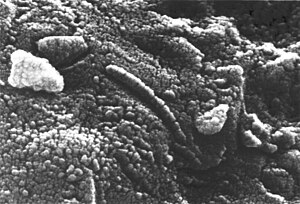
So, for those who were hoping for evidence of alien life, stay tuned. I will not be surprised if we see exactly that announcement from NASA, specifically JPL, in the next few weeks. Or very early in 2011. Peer review is a slow and arduous process, but it looks like they may have some very interesting things in the works. Not new data, but new analysis of old data. Meaning, we may have seen our first alien life 14 years ago, correctly identified it as such, and then subsequently misidentified it as something else. Such is science. But it seems that possibly the martian meteorites ALH 84001, Nakhla and others may in fact contain fossilized nanobacteria after all. We'll see.
So, for those who were hoping for evidence of alien life, stay tuned. I will not be surprised if we see exactly that announcement from NASA, specifically JPL, in the next few weeks. Or very early in 2011. Peer review is a slow and arduous process, but it looks like they may have some very interesting things in the works. Not new data, but new analysis of old data. Meaning, we may have seen our first alien life 14 years ago, correctly identified it as such, and then subsequently misidentified it as something else. Such is science. But it seems that possibly the martian meteorites ALH 84001, Nakhla and others may in fact contain fossilized nanobacteria after all. We'll see.
Thursday, December 2, 2010
Iron Lisa and the Arsenic Prokaryotes
NASA's press conference this morning didn't disappoint.
When I saw that Mary Voytek, Felisa Wolfe-Simon and Pamela Conrad were going to be keynoting the NASA press conference today, I knew this was going to be something big. There had been a lot of speculation (and hype) that NASA had found solid evidence of life on Mars, Enceladus or Titan. With the exception of finding thriving life on Titan (which today's announcement may well point toward), what actually was announced today is far more mind-shattering than any of these. Geomicrobiologist Felisa "Iron Lisa" Wolfe-Simon and her team at Mono Lake CA found a halobacteria which in the absence of phosphorus is building its DNA out of arsenic.
Which means, or at least implies, that life could be constructed not only out of the traditional terrestrial "CHONPS" elements (carbon, hydrogen, oxygen, nitrogen, phosphorus and sulfur) but conceivably out of any any combination of elements, so long as their outer valences matched up.

Many thousand thanks and congratulations to Iron Lisa and her team!
Here's the full article in Astrobiology Magazine:
When I saw that Mary Voytek, Felisa Wolfe-Simon and Pamela Conrad were going to be keynoting the NASA press conference today, I knew this was going to be something big. There had been a lot of speculation (and hype) that NASA had found solid evidence of life on Mars, Enceladus or Titan. With the exception of finding thriving life on Titan (which today's announcement may well point toward), what actually was announced today is far more mind-shattering than any of these. Geomicrobiologist Felisa "Iron Lisa" Wolfe-Simon and her team at Mono Lake CA found a halobacteria which in the absence of phosphorus is building its DNA out of arsenic.
Which means, or at least implies, that life could be constructed not only out of the traditional terrestrial "CHONPS" elements (carbon, hydrogen, oxygen, nitrogen, phosphorus and sulfur) but conceivably out of any any combination of elements, so long as their outer valences matched up.
Many thousand thanks and congratulations to Iron Lisa and her team!
Here's the full article in Astrobiology Magazine:
Wednesday, December 1, 2010
NASA press conference on astrobiology discovery tomorrow
NASA has announced a press conference on a new astrobiology
discovery scheduled for tomorrow morning at 11am pst.
Looking at the list of names below who are involved in the
press conference, there are a lot of really big guns here.
Specifically in the fields of exobiology and extremophile
terrestrial biology.
Based on this, there has been a lot of speculation that NASA
has found significant evidence of extraterrestrial life. One
of the possibilities I've seen circulating is that the Cassini
mission may have found evidence of life on Titan or Enceladus.
Another possibility is that the remaining rover Opportunity
may have found organic fossils (or life) on Mars.
Any of these are possible. It could also be something rather less
exciting, or, conceivably, something even more exciting. Personally,
I'm not going to speculate,at least not publicly. But I do know that
my OUPV students will be getting their lunch break an hour early
tomorrow.
Will post more tomorrow, when we'll all know.

=================================

NASA SETS NEWS CONFERENCE ON ASTROBIOLOGY DISCOVERY;
SCIENCE JOURNAL HAS EMBARGOED DETAILS UNTIL 2 P.M. EST ON DEC. 2

WASHINGTON -- NASA will hold a news conference at 2 p.m. EST on
Thursday, Dec. 2, to discuss an astrobiology finding that will impact
the search for evidence of extraterrestrial life. Astrobiology is the
study of the origin, evolution, distribution and future of life in
the universe.

The news conference will be held at the NASA Headquarters auditorium
at 300 E St. SW, in Washington. It will be broadcast live on NASA
Television and streamed on the agency's website at
http://www.nasa.gov.

Participants are:
-     Mary Voytek, director, Astrobiology Program, NASA Headquarters,
Washington
-     Felisa Wolfe-Simon, NASA astrobiology research fellow, U.S.
Geological Survey, Menlo Park, Calif.
-     Pamela Conrad, astrobiologist, NASA's Goddard Space Flight
Center, Greenbelt, Md.
-     Steven Benner, distinguished fellow, Foundation for Applied
Molecular Evolution, Gainesville, Fla.
-     James Elser, professor, Arizona State University, Tempe

Media representatives may attend the conference or ask questions by
phone or from participating NASA locations. To obtain dial-in
information, journalists must send their name, affiliation and
telephone number to Steve Cole at stephen.e.cole@nasa.gov or call
202-358-0918 by noon Dec. 2.

For NASA TV streaming video and downlink information, visit:

http://www.nasa.gov/ntv

For more information about NASA astrobiology activities, visit:

http://astrobiology.nasa.gov
Subscribe to:
Posts (Atom)